
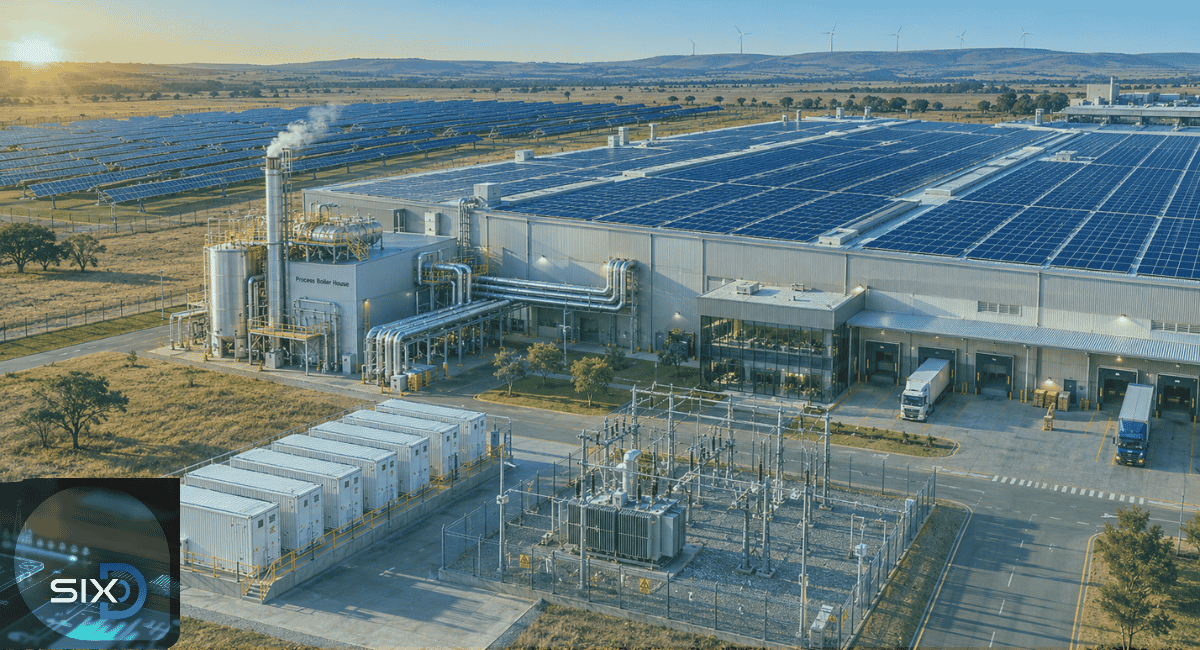
Quick Answer
Industrial renewable energy is the large-scale generation, procurement and use of renewable energy, such as solar, wind, biomass and geothermal, to power factories, mines and processing plants. It includes renewable electricity, renewable process heat, green hydrogen, battery storage, hybrid microgrids and procurement through PPAs and wheeling.
For South African manufacturers, mines and processors, energy is no longer just an overhead. Eskom's direct-customer tariffs rose by 8.76% in April 2026, and the carbon tax rate jumped to R308 per tonne of CO2e when Phase 2 began on 1 January 2026. Industrial renewable energy has therefore become a question of cost, competitiveness and compliance.
This guide explains what industrial renewable energy is, which technologies it includes and how South African industrial operations can buy, generate and integrate it. If you run offices, retail or warehouse space, see our companion guide to commercial renewable energy.
What Is Industrial Renewable Energy?
Industrial renewable energy is the use of naturally replenishing energy sources to supply heavy-use operations such as manufacturing plants, mines, smelters, food processors, chemical plants and industrial parks. It covers both electricity and heat, because many industrial processes run on steam, hot water or direct heat rather than electricity alone.
Unlike commercial systems, industrial installations must serve large motors, compressors, pumps, furnaces and continuous production lines. As a result, an industrial renewable energy project is an engineering project first. It has to protect power quality, production uptime and safety, not only reduce the energy bill.
Commercial vs Industrial Renewable Energy
| Factor | Commercial | Industrial |
|---|---|---|
| Typical sites | Offices, retail, warehouses, hotels, schools | Factories, mines, smelters, processing plants, industrial parks |
| Typical scale | Tens of kilowatts to around 1 MW | Often several megawatts or more |
| Energy needs | Mainly electricity for lighting, HVAC and IT | Electricity plus process heat, steam and cooling |
| Load profile | Mostly daytime | Shift-based or 24/7, with large motor starting currents |
| Grid connection | Usually low voltage | Usually medium or high voltage |
| Key priorities | Tariff savings and continuity | Uptime, power quality, energy cost and emissions |
What Does Industrial Renewable Energy Include?
Industrial renewable energy includes three groups: the core generation technologies, the industrial process applications they serve, and the enabling infrastructure and procurement models that make them work.
Core Industrial Renewable Energy Technologies
| Technology | Industrial Use | South African Fit |
|---|---|---|
| Solar PV | Rooftop and ground-mounted arrays supplying plant electricity | Excellent. Strong irradiation and large roofs or land on most sites |
| Solar thermal and CSP | Heat for hot water, steam, drying and other process heat | Good for low and medium-temperature processes in sunny regions |
| Wind | Onshore turbines supplying large volumes of electricity | Strong in the Cape provinces. Usually accessed through PPAs and wheeling |
| Biomass and bioenergy | Residues, biogas and waste converted into heat, steam or power | Strong where sugar, timber, agri-processing or food waste is available |
| Geothermal | Deep earth heat for baseload power or direct heating | Limited. South Africa lacks high-temperature geothermal resources |
| Hydropower and ocean energy | Flowing water or marine energy for electricity | Site-specific and uncommon for industrial sites |
1. Industrial Solar PV
Solar PV is the most accessible industrial renewable energy technology in South Africa. Factory and warehouse roofs, carports and unused land next to a plant can host large arrays that supply motors, compressors, pumps, HVAC and lighting.
The greatest value comes from consuming most of the solar output on site as it is generated. Therefore, the system should be sized to the plant's daytime base load, not to the available roof area. Larger sites often add ground-mounted arrays or single-axis trackers to increase yield.
2. Solar Thermal and Concentrated Solar Power
By contrast, solar thermal systems capture sunlight as heat rather than converting it to electricity. For example, this heat can preheat boiler feedwater, supply hot water for washing and cleaning or provide heat for drying. Concentrated solar power (CSP) uses mirrors to reach higher temperatures, and South Africa already hosts several utility-scale CSP plants in the Northern Cape.
However, suitability depends on the required process temperature, operating hours and available space, so solar thermal is usually assessed process by process.
3. Wind Energy
Wind turbines can supply large volumes of electricity, often at night and in winter when solar output is lower. As a result, wind and solar complement each other well. South Africa's best wind resources are in the Eastern, Western and Northern Cape, so most industrial users access wind power through power purchase agreements and wheeling rather than turbines on their own sites.
4. Biomass and Bioenergy
Bioenergy, meanwhile, converts organic material into heat, steam, electricity or fuel. Common industrial feedstocks also include bagasse from sugar mills, wood and forestry residues, agricultural residues, food-processing waste and biogas from anaerobic digestion.
Globally, bioenergy is still by far the largest renewable source of industrial heat, according to the International Energy Agency (IEA). Consequently, it works best where a plant already produces suitable residues, which also turns a waste stream into an energy asset.
5. Geothermal, Hydropower and Ocean Energy
Geothermal energy can provide steady baseload power and heat, but only where high-temperature resources exist. South Africa lacks these resources, so geothermal power is not a practical option for local industry. Similarly, hydropower and ocean energy depend on specific sites and are rarely suitable for a typical industrial facility.
Industrial Process Applications
Renewable Process Heat and Cooling
In addition to electricity, heat is one of the largest and hardest-to-decarbonise parts of industrial energy use. Textile dyeing, agri-processing, food and beverage production, chemicals and metal processing all depend on heat that has traditionally come from coal, gas, diesel or heavy fuel oil.
Industrial renewable energy can replace much of this heat in several ways:
- Industrial heat pumps: Now meet process temperatures of up to about 200°C, according to the IEA, and can recover waste heat at the same time.
- Electric boilers: Produce steam or hot water from renewable electricity.
- Solar thermal: Supplies low and medium-temperature heat directly from the sun.
- Biomass boilers: Burn residues to produce steam for process use.
- Renewable-powered cooling: Chillers and refrigeration plants running on solar power during the day.
Very high-temperature processes, such as steelmaking and cement kilns, have fewer options today. For this reason, industrial energy planning must start with the process and its temperature needs, not with a preferred technology.
Green Hydrogen and Derivatives
Next, green hydrogen is produced by using renewable electricity to split water through electrolysis. It can serve as a feedstock for green ammonia, fertilisers and chemicals, as a reducing agent in green steel and as a fuel for high-temperature heat.
Green hydrogen matters most in sectors where direct electrification is difficult. However, it is still costly and energy-intensive to produce. For most factories, solar PV, storage, heat pumps and efficiency upgrades will deliver a faster return, while green hydrogen remains a longer-term option for heavy industry.
Enabling Infrastructure for Industrial Renewable Energy
Battery Energy Storage Systems (BESS)
A battery energy storage system stores electricity for later use. It is not a renewable source in itself, but it makes renewable generation far more useful to an industrial site.
In industry, a BESS can support:
- Maximum demand management: Discharging during demand peaks to cut maximum demand charges.
- Time-of-use optimisation: Shifting energy away from expensive peak periods on tariffs such as Eskom's Megaflex.
- Critical load protection: Keeping control systems, safety systems and sensitive processes running during outages.
- Solar smoothing: Stabilising output when clouds pass over large arrays.
- Higher self-consumption: Storing midday solar surplus for evening shifts.
Because batteries are capital-intensive, they must be sized against the load profile, tariff structure and required backup duration. At grid scale, pumped hydro storage plays a similar role, but it is a utility asset rather than an on-site industrial option.
Hybrid Systems and Industrial Microgrids
Most industrial renewable energy systems are hybrid. For example, a plant may combine solar PV, battery storage, grid supply, diesel or gas generators and wheeled wind power.
When these resources are controlled as one local network, the result is an industrial microgrid. Such a microgrid can prioritise critical loads, keep production running through grid disturbances and operate in island mode where the design allows. Likewise, remote mines and off-grid sites can run fully off-grid hybrid systems that reduce diesel use.
Energy Management, Automation and Load Control
Meanwhile, an energy management system (EMS) coordinates generation, storage and consumption in real time. It tracks solar output, grid imports, battery state of charge, maximum demand and energy use by process or department.
When the EMS is linked to plant automation, the site can also shift flexible loads, such as pumping, chilling, compressed air or batch processes, into periods of high solar output or low tariffs. Connected IoT monitoring provides the data needed to verify savings and report Scope 1 and Scope 2 emissions.
Electrical Integration and Grid Compliance
Above all, connecting several megawatts of renewable generation to an industrial network is a significant electrical engineering task. It typically requires:
- Load flow, fault level and protection coordination studies.
- Power quality analysis, including harmonics from inverters and variable speed drives.
- MV switchgear, transformers and electrical infrastructure upgrades.
- Earthing, lightning and surge protection for large PV arrays.
- Compliance with NRS 097-2 for low-voltage connections, or the South African grid connection code for renewable power plants and battery facilities on larger MV and HV connections.
- Utility approval, a Certificate of Compliance and registration with NERSA where required.
Our guide to what an industrial electrical construction project should include covers these engineering stages in more detail.
How Industrial Businesses Buy Renewable Energy
| Model | How It Works | Best For |
|---|---|---|
| On-site self-generation | The business owns solar, storage or bioenergy on its own site | Plants with roof or land space and a taxable income for Section 12B |
| On-site PPA | A developer funds and operates the plant, and the business pays per kWh | Sites that want savings without capital outlay |
| Off-site corporate PPA | Power from a remote solar or wind farm is delivered over the grid | Large or 24/7 users that need more energy than their site can produce |
| Wheeling | Electricity is transported over Eskom or municipal networks to the buyer | Multi-site groups and energy-intensive operations |
| Hybrid procurement | On-site solar plus storage, grid and wheeled renewable supply | Most medium and large industrial users |
Corporate PPAs and Wheeling
First, a power purchase agreement (PPA) is a long-term contract to buy electricity at an agreed price, usually for 10 to 20 years. Then, through wheeling, a wind farm in the Eastern Cape or a solar plant in the Northern Cape can supply a factory in Gauteng over existing networks.
In May 2025, the Department of Electricity and Energy published updated wheeling rules to open third-party access to Eskom and municipal grids. In addition, the Electricity Regulation Amendment Act, in force since 1 January 2025, is moving South Africa towards a competitive wholesale electricity market. Together, these reforms give industrial buyers far more choice than a few years ago.
Industrial Renewable Energy in South Africa
Several policy and market drivers now support industrial renewable energy in South Africa:
- Rising electricity costs: Eskom tariffs rose by 12.74% in April 2025 and 8.76% in April 2026, making self-generation and PPAs more attractive.
- Carbon tax Phase 2: From 1 January 2026, the rate increased from R236 to R308 per tonne of CO2e, raising the cost of fossil-fuel process heat for liable emitters.
- Section 12B: Businesses can deduct the cost of owned renewable generation assets, with 100% in year one for solar PV of 1 MW or less and 50%, 30% and 20% over three years for larger systems, per SARS guidance.
- No generation licence for own use: Private embedded generation no longer needs a NERSA licence, although larger grid-connected facilities must still register.
- Renewable Energy Masterplan: Cabinet approved the South African Renewable Energy Masterplan in March 2025 to build local solar PV, wind and battery storage value chains.
- Export pressure: Exporters face growing demand to prove low-carbon production, including under the EU's carbon border adjustment mechanism.
However, tax and regulatory positions differ by company, so businesses should confirm specifics with their tax and legal advisers.
Benefits of Industrial Renewable Energy
- Lower energy costs: Self-generated and contracted renewable power reduces grid purchases and maximum demand charges.
- Price certainty: Long-term PPAs and owned assets protect margins against tariff increases.
- Lower carbon tax exposure: Replacing fossil-fuel process heat reduces direct emissions and carbon tax liability.
- Production resilience: Hybrid systems and microgrids protect critical processes during grid disturbances.
- Market access: Verified renewable supply helps exporters and suppliers meet customer and ESG requirements.
- Better use of assets: Roofs, land and organic waste streams become productive energy assets.
How to Start an Industrial Renewable Energy Project
- Energy audit: Analyse at least 12 months of electricity and fuel data, including interval meter data.
- Load and heat profile: Map base load, maximum demand, shift patterns, critical loads and process temperatures.
- Efficiency first: Address compressed air leaks, motor efficiency, VSDs, insulation and waste heat recovery.
- Technology selection: Match solar, storage, heat pumps, bioenergy or wheeled supply to the actual demand.
- Electrical studies: Complete grid, protection and power quality studies before final design.
- Commercial model: Compare ownership, PPA and wheeling options, including Section 12B and carbon tax effects.
- Approvals and construction: Secure utility, NERSA and grid code approvals, then install and commission.
- Monitor and optimise: Use an EMS to verify performance and refine control strategies over time.
How SixD Delivers Industrial Renewable Energy Solutions
SixD delivers industrial renewable energy solutions for manufacturing, mining, agricultural and energy clients, including commercial and industrial solar PV, battery energy storage, embedded generation, microgrids, utility-scale projects and smart energy management.
Because we are also an industrial electrical contractor, we handle the part many renewable projects underestimate: integrating new generation safely into existing MV and LV networks, protection schemes and process controls. In addition, our IoT monitoring, risk intelligence and asset integrity services help keep your energy system performing for its full design life.
Planning an Industrial Renewable Energy Project?
Talk to SixD about an energy assessment for your plant and find the right mix of generation, storage, integration and supply.

