
Quick Answer
Commercial renewable energy is electricity or heat from naturally replenishing sources, mainly solar, plus wind, hydro, bioenergy and geothermal, used to power businesses and non-residential buildings. It includes on-site generation such as rooftop solar PV, battery storage, energy management systems, and off-site supply through wheeling and power purchase agreements (PPAs).
Commercial renewable energy has moved from a sustainability talking point to a core business decision in South Africa. Eskom's direct tariffs rose by 12.74% in April 2025 and a further 8.76% in April 2026, with municipal increases of 9.01% from July 2026. As a result, businesses are looking for ways to control what they pay for power, not only how reliably they receive it.
This guide explains what commercial renewable energy is, what a complete commercial system includes, how South African businesses pay for it and which approvals apply. It focuses on commercial properties such as offices, retail centres, warehouses, hotels, schools and hospitals. We cover heavy industry and mining in a separate guide to industrial renewable energy.
What Is Commercial Renewable Energy?
Commercial renewable energy is energy from renewable sources that is generated, stored or bought by businesses and other non-residential organisations. It sits between residential systems, which power a single home, and industrial systems, which power plants, mines and heavy process loads.
In practice, a commercial renewable energy solution is rarely just a set of solar panels. It is an engineered system that combines generation, storage, electrical integration and monitoring, and it is often paired with an off-site supply contract. The goal is lower and more predictable energy costs, better continuity and measurable progress on sustainability targets.
Commercial vs Residential vs Industrial Renewable Energy
| Factor | Residential | Commercial | Industrial |
|---|---|---|---|
| Typical sites | Homes and complexes | Offices, retail, warehouses, hotels, schools, hospitals, farms | Factories, mines, processing plants |
| Typical system size | Roughly 3 to 15 kWp | Roughly 30 kWp to 1 MWp+ | Multi-megawatt |
| Load profile | Morning and evening peaks | Mostly daytime, close to solar output | Often 24/7 with large motor loads |
| Main drivers | Backup and bill savings | Tariff savings, continuity, ESG reporting | Process uptime, energy cost, emissions |
| Grid connection | Low voltage | Usually low voltage, sometimes MV | Mostly medium or high voltage |
What Does Commercial Renewable Energy Include?
Commercial renewable energy includes three layers: the renewable sources themselves, the on-site technologies that generate and store power, and the off-site and financial arrangements that let a business buy clean electricity it does not produce itself.
The Five Renewable Energy Sources
| Source | How It Works | Commercial Use in South Africa |
|---|---|---|
| Solar PV | Panels convert sunlight into electricity | The most practical option. Installed on roofs, carports or open land |
| Wind | Turbines convert moving air into electricity | Rarely viable on site. Usually accessed off site through wheeling or PPAs |
| Hydropower | Flowing or falling water drives turbines | Limited local resource. Accessed mainly through the grid or off-site supply |
| Bioenergy and biogas | Organic waste or biomass is converted into gas, heat or power | Suits farms, food processors and sites with steady organic waste |
| Geothermal | Heat from the earth is used for power or heating | Not practical for power locally. Ground-source heat pumps can cut heating and cooling loads |
For most South African businesses, solar PV is the starting point. The country has strong year-round sunshine, and commercial sites use most of their electricity during daylight hours. In fact, rooftop solar capacity in South Africa has passed 8.3 GW, and most of it sits on commercial sites such as malls, warehouses and farms rather than homes.
On-Site Commercial Renewable Energy Systems
1. Commercial Solar PV
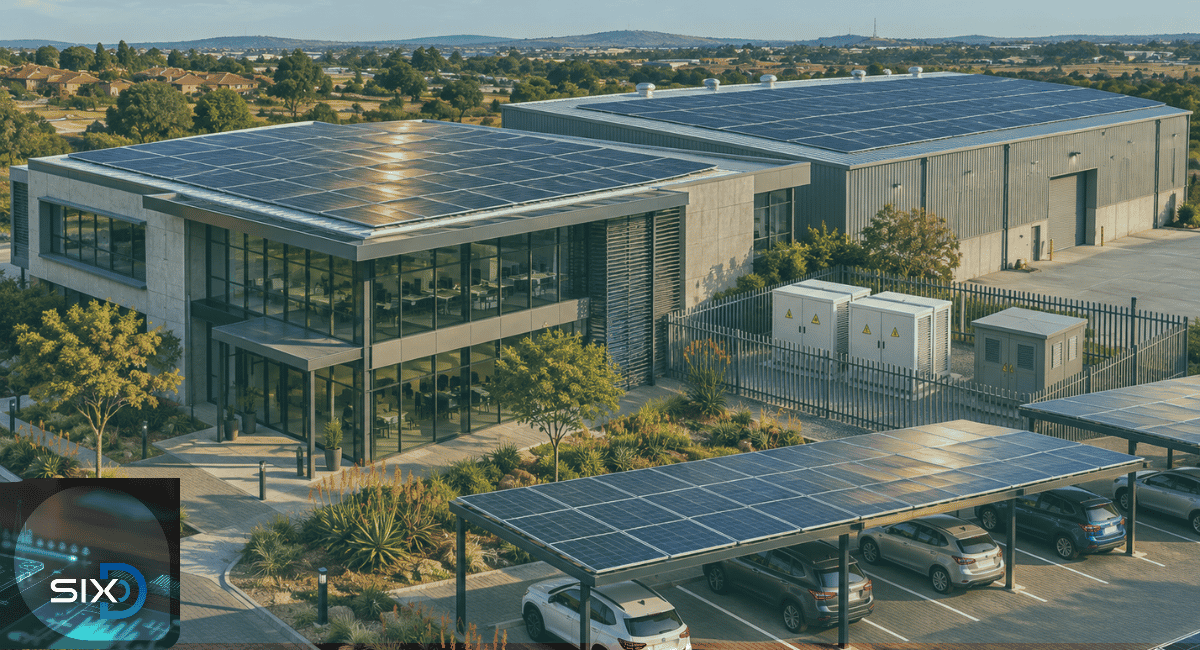
Commercial solar PV converts sunlight into electricity that the business uses directly. Generally, panels can be mounted on rooftops, on solar carports over parking areas or on ground-mounted structures where land is available.
Commercial solar works especially well for:
- Offices and business parks: Air conditioning, lighting and IT loads peak during working hours.
- Shopping centres and retail: Large roof areas and long trading hours with heavy cooling and refrigeration loads.
- Warehouses and logistics centres: Very large, unshaded roofs with modest daytime loads, ideal for high self-consumption.
- Hotels, hospitals and schools: Steady daytime demand and a strong need for continuity.
- Farms and agri-processing: Irrigation pumps, cold rooms and packhouses that run mainly by day.
However, before installation, the roof structure should be assessed for the added load, and the system must be sized to the site's real consumption profile rather than the available roof space.
2. Battery Energy Storage Systems (BESS)
A battery energy storage system stores electricity for use at another time. It is important to note that a battery is not a renewable energy source. Instead, it makes renewable energy more useful by shifting solar power into periods when the sun is not shining.
For example, in a commercial setting, a BESS can support:
- Peak shaving: Reducing maximum demand charges by discharging during peak consumption.
- Time-of-use savings: Charging when electricity is cheap and discharging during expensive peak periods.
- Backup power: Keeping critical loads running during outages or load-shedding.
- Higher solar self-consumption: Storing midday surplus instead of exporting it at a low rate or curtailing it.
Because batteries add significant cost, they should be justified by a clear tariff, demand or continuity case rather than added by default.
3. Hybrid Systems and Backup Integration
Many commercial renewable energy systems are hybrid. They coordinate the grid, solar PV, batteries and an existing diesel generator through hybrid inverters and automatic changeover equipment. As a result, the site draws on the cheapest available source and switches seamlessly when one supply fails.
However, getting this right depends on the existing electrical infrastructure. For instance, distribution boards, protection settings, earthing and transformer capacity often need upgrades before a hybrid system can connect safely.
4. Energy Management and Monitoring
Finally, an energy management system (EMS) turns a commercial renewable energy installation into a controllable asset. It shows, in real time, how much power is generated, stored, imported and consumed, and where it is used.
Smart metering and IoT-enabled monitoring also let the system automate decisions, such as when to charge batteries, when to shed non-critical loads and how to keep demand below a set limit. In addition, verified data supports ESG and Scope 2 emissions reporting, which tenants, lenders and corporate clients increasingly expect.
Off-Site Commercial Renewable Energy: Wheeling and PPAs
Not every business has the roof space or load profile to meet its needs on site. Instead, off-site procurement lets a business buy renewable electricity that is generated somewhere else.
Electricity Wheeling
Wheeling is the transport of electricity from a generator to a customer in another location over existing Eskom or municipal networks. For example, a solar or wind farm in the Northern Cape can supply a retail group whose stores are in Gauteng. In May 2025, the Department of Electricity and Energy published updated wheeling rules to open third-party access to these networks, and the Electricity Regulation Amendment Act is moving the sector towards a competitive electricity market.
Power Purchase Agreements (PPAs)
A power purchase agreement is a long-term contract to buy electricity at an agreed rate. Commercial businesses typically use two types:
- On-site PPA: A third party funds, owns and maintains a solar system on the business's roof, and the business pays only for the electricity it uses, usually below grid tariffs.
- Off-site or wheeled PPA: The business buys power from a remote renewable plant, delivered through the grid via wheeling. Virtual or aggregated arrangements can combine several sites or generators.
In practice, the strongest commercial strategies often combine on-site solar, storage, grid supply and off-site procurement.
How Businesses Pay for Commercial Renewable Energy
| Model | How It Works | Best For |
|---|---|---|
| Cash purchase (capex) | The business owns the system outright | Taxpaying businesses that can use the Section 12B deduction |
| Asset finance or green loan | The system is financed and owned by the business | Preserving cash flow while keeping ownership benefits |
| Rental or lease | A fixed monthly fee covers the system and maintenance | Predictable costs with limited upfront spend |
| On-site PPA | Pay per kWh consumed, with no capital outlay | Landlords and businesses that prefer operating costs |
| Off-site PPA via wheeling | Buy renewable power generated elsewhere | Larger or multi-site businesses with limited roof space |
The Section 12B Tax Incentive
Under Section 12B of the Income Tax Act, a business can deduct 100% of the cost of a solar PV system of 1 MW or less in the year it is first brought into use. Systems above 1 MW are deducted over three years at 50%, 30% and 20%. However, the business must own the asset and use it for its trade. Note that the temporary 125% Section 12BA incentive ended on 28 February 2025, so new projects now fall under Section 12B. Therefore, businesses should confirm eligibility with their tax adviser.
Commercial Renewable Energy Compliance in South Africa
A grid-connected commercial system is an embedded generation installation, so it must be approved and certified before it operates. Key requirements include:
- Utility approval: An application to the local municipality or Eskom before connecting any small-scale embedded generation (SSEG) system to the grid.
- NRS 097-2 compliance: Grid-tied inverters and protection must meet the NRS 097-2 grid connection requirements.
- SANS 10142-1 and 10142-1-2: The installation must follow the wiring standards for low-voltage and embedded generation installations.
- Certificate of Compliance: A registered person must issue a CoC and test report for the installation.
- NERSA registration: Larger grid-connected generation facilities must also be registered with the National Energy Regulator.
- Structural and building approvals: Roof loading checks and, where the municipality requires it, building plan approval.
Moreover, requirements vary by municipality and system size, which is why an experienced engineering partner should manage approvals from the outset.
Benefits of Commercial Renewable Energy
- Lower electricity costs: Every kilowatt-hour generated on site is one less bought at rising grid tariffs.
- Price certainty: A PPA or owned system locks in a large share of energy costs for 15 to 25 years.
- Business continuity: Solar with storage protects critical loads, refrigeration, security and IT during outages.
- ESG and reporting: Measured renewable supply reduces Scope 2 emissions and supports green building ratings.
- Property value: Energy-efficient commercial buildings are more attractive to tenants, buyers and lenders.
- Tax efficiency: Section 12B can significantly reduce the after-tax cost of a qualifying solar system.
How to Start a Commercial Renewable Energy Project
A successful project starts with data, not a standard package. Follow these steps:
- Energy audit: Analyse at least 12 months of bills and, ideally, half-hourly meter data.
- Load profile: Identify base load, peak demand, critical loads and time-of-use exposure.
- Site assessment: Check roof condition, structure, shading, orientation and available land.
- Electrical review: Assess distribution boards, protection, earthing and supply capacity.
- Financial modelling: Compare purchase, finance, rental and PPA options, including Section 12B.
- Approvals: Submit SSEG and, where needed, NERSA and building applications.
- Installation and commissioning: Install, test and commission to SANS and NRS requirements.
- Monitoring and maintenance: Track performance and keep the system delivering its projected savings.
How SixD Delivers Commercial Renewable Energy Solutions
SixD designs and delivers renewable energy solutions for commercial, industrial and agricultural organisations, including commercial solar PV, battery energy storage, hybrid systems, embedded generation, microgrids and smart energy management.
What sets us apart is that we treat energy as part of your operating infrastructure. Our teams combine electrical construction, infrastructure engineering, IoT monitoring and risk intelligence, so every system is sized, connected and managed around how your business actually uses power. Then, after commissioning, our asset integrity and reliability services help protect long-term performance.
Planning a Commercial Renewable Energy Project?
Talk to SixD about an energy assessment for your property and find the right mix of solar, storage and supply for your business.

